
Food Waste Three-Phase Separation Project
LWS350×1550CX Three-Phase Decanter Centrifuge for Oil-Water-Solid Separation in Food Waste Treatment
Project Background
A technology company runs a food waste treatment plant that processes collected food waste through three-phase separation. The incoming waste goes through pre-treatment—sorting, crushing, and screw pressing—before the separation stage.
The feed is mechanically processed food waste slurry containing solids, water, and oil that need separating. Feed temperature runs 50-70°C, with total solids (TS) at 10-17% (about 5-6% soluble matter, roughly 3% oil).
Customer Challenges
- Feed solids vary 10-17%, so the separator needs to handle these changes without losing separation quality
- Separation targets are tight: oil phase moisture ≤5%, water phase oil ≤0.5%, solid phase moisture ≤80%
- Feed contains non-metallic particles up to 50 mm and hard particles 0.5-1 mm, which increases wear on internal components
- Plant runs 24 hours, continuous or batch, so equipment downtime needs to be minimal
- Feed characteristics change during operation, but separation quality must stay consistent
- Solid discharge connects to a screw conveyor via flexible connection, so sealing and material flow need to work reliably
ZK SEPARATION Solution
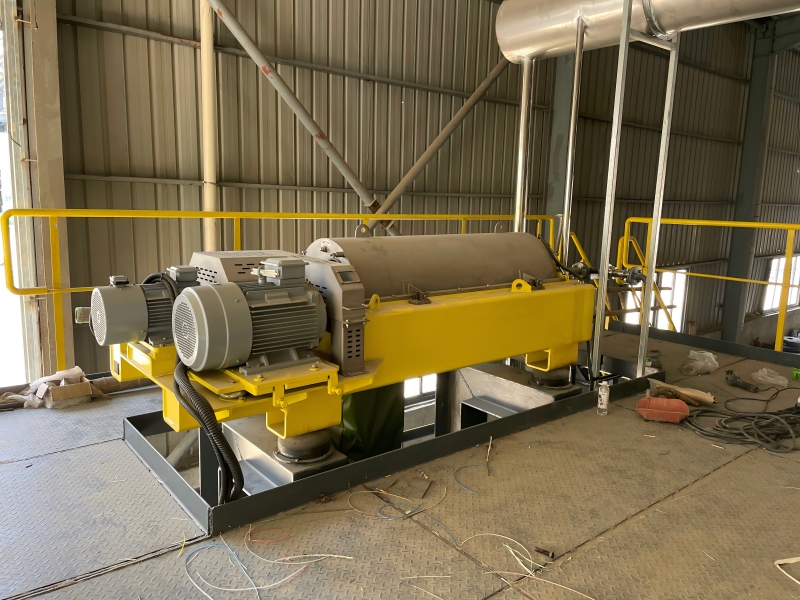
The plant installed one LWS350×1550CX three-phase decanter for the separation stage. The unit has a flexible connection at the solid discharge end that feeds into a screw conveyor.
Process Role
The decanter sits after pre-treatment (sorting, crushing, screw pressing). Pre-treated slurry feeds in at 50-70°C. The unit separates three streams: oil from the heavy liquid outlet, water from the light liquid outlet, and solids from the conveyor end through the flexible connection to the screw conveyor.
Equipment Configuration
-
Three-Phase Separation Design
Dual weir plates separate the heavy liquid (oil) and light liquid (water) phases. The scroll discharges solids at the opposite end
-
Flexible Solid Discharge Connection
Flexible connection at the solid discharge end connects to the screw conveyor. This design seals properly and handles material flow without needing precise alignment
-
Material Construction
Bowl is 2205 duplex stainless steel, scroll is 316 stainless steel. This material selection handles the corrosive food waste environment
-
Control and Monitoring
PLC control lets operators adjust differential speed and weir plate positions to tune separation when feed characteristics change
Project Overview
- Customer Industry Food Waste Treatment
- Application Three-Phase Separation
- Material Source Food Waste Slurry (Pre-treated)
- Equipment Model LWS350×1550CX
- Number of Units 1
- Processing Capacity ≥ 5 m³/h
- Feed Temperature 50-70°C
- Feed Solid Content (TS) 10-17%
- Separation Type Three-Phase
Installation and Operation
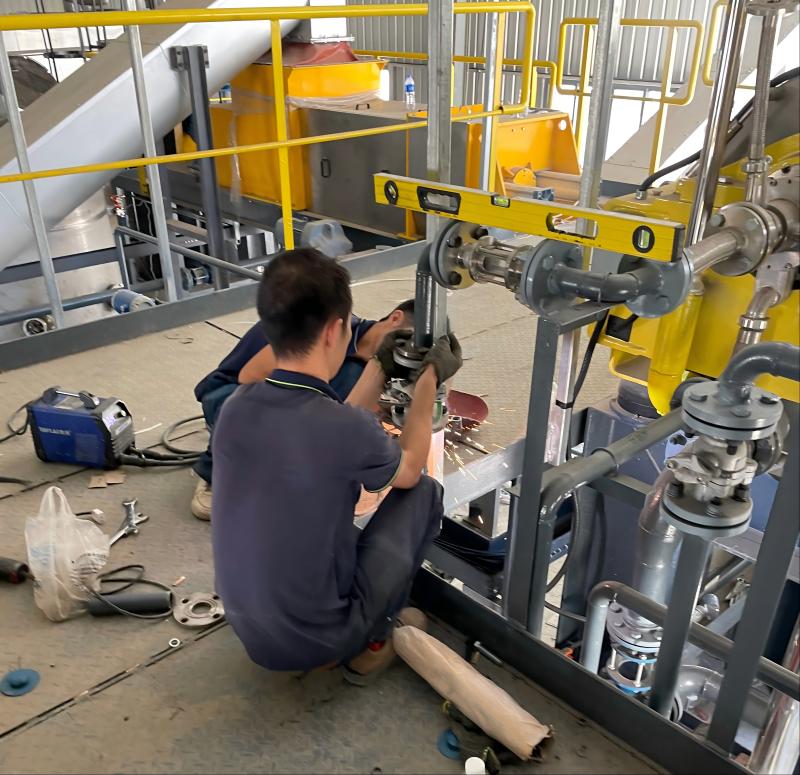
The LWS350×1550CX is installed in the separation section. It runs continuously or in batches as needed, separating oil, water, and solids from the pre-treated slurry.
Performance & Results
- Processing Capacity: Operating throughput ≥ 5 m³/h, which meets the plant's processing needs
- Separation Quality: Oil phase moisture ≤5%, water phase oil ≤0.5%, solid phase moisture ≤80%. All targets are met
- Operational Stability: Separation stays consistent even when feed solids vary between 10-17%
- Continuous Operation: Unit handles 24-hour continuous or batch operation as the plant schedule requires
- Material Handling: Flexible connection at the solid discharge end works reliably with the screw conveyor for downstream handling
- Equipment Reliability: 2205 duplex stainless steel bowl and 316 stainless steel scroll handle the corrosive food waste environment
LWS350×1550CX Technical Specifications
Equipment Parameters
- Bowl Diameter: 350 mm
- Operating Speed: 4000 r/min
- Separation Factor: 3136 G
- Main Motor Power: 22 kW
- Auxiliary Motor Power: 5.5 kW
- Lubrication: Grease lubrication
- Bowl Material: 2205 Duplex Stainless Steel
- Scroll Material: 316 Stainless Steel
- Overall Dimensions: 3300×1040×1310 mm
- Weight: 2800 kg
Separation Performance
The LWS350×1550CX meets the separation targets for this food waste application. Operators can adjust weir plate positions and differential speed to optimize separation when feed characteristics change.
Material Handling
The flexible connection at the solid discharge end maintains proper material flow to the screw conveyor while keeping a good seal. This design handles installation tolerances and keeps material transfer reliable.